Sylvia Ngige Where women’s power meets real life
By Sylvia Ngige | http://www.sylviangige.com
Mama Ifeoma told me: “My daughter asked why she bleeds every month. I had no answer.” That question broke me. Because millions of Nigerian girls are cut before they can ask questions.
FGM isn’t “women’s business”. It’s our national business. Here’s what the data says, and what women can do:
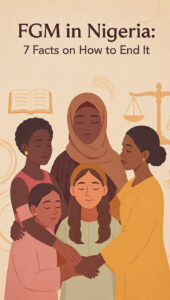
7 Facts Every Anambra Woman Should Know
1. The Scale in Nigeria
Nigeria accounts for about 1 in 10 women globally who have undergone FGM — roughly 19.9 million women and girls as of UNICEF 2024 data. That’s more than the population of Lagos + Kano combined.
2. Where It’s Most Common
Prevalence varies by zone. NDHS 2018 + UNICEF 2024 show highest rates in South-East, South-West, South-South. Ebonyi 74%, Osun 72%, Imo 69%. But it’s practiced across all zones and by multiple ethnic groups. It’s not one tribe’s problem. It’s all of us.
3. Age is Dropping
The trend is shifting younger. More girls are cut before age 5, and even in infancy, to avoid detection and “vacation cutting” when girls visit villages during holidays. If we wait till she’s 15 to talk, we’re late.
4. Health Impact is Real
WHO confirms FGM has zero health benefits. Short-term risks include severe pain, bleeding, infections, urinary problems. Long-term risks include complications during childbirth, need for c-sections, newborn death, and psychological trauma. Any health issues after FGM need assessment by a doctor, nurse, or midwife — don’t self-treat.
5. The Law is Clear
Nigeria’s Violence Against Persons Prohibition Act, VAPP 2015, Section 6 makes FGM a crime nationwide. Punishment: up to 4 years in prison, or fine, or both. Anambra State has the “Anambra State Violence Against Persons Prohibition Law” which also bans it. The law exists. Enforcement is our work.
6. It’s Driven by Myths, Not Medicine
Common reasons cited: “to preserve virginity”, “for cultural acceptance”, “to increase marriage chances”, “for cleanliness”. None are supported by science. Girls who are not cut marry, succeed, and lead. Chidimma Adetshina. Ngozi Okonjo-Iweala. Whole.
7. The Trend Can Change*
UNICEF data shows attitudes are shifting. Among Nigerian women aged 15-49, the percentage who believe FGM should continue dropped from 30% in 2013 to 19% in 2021. When mothers say “no”, the practice drops. That’s women’s power meeting real power.
Sylvia’s 3-Point Action Plan for 2026-2030
1. Talk in Circles of Trust
Bring it up in your women’s meeting, church group, market association, age grade. Use this line: “If the table is dirty, bring your wrapper”. FGM is a dirty table. We sanitize it by speaking.
2. Protect During Holidays
“Vacation cutting” peaks Nov-Dec and July-Aug. Before school closes, tell teachers, aunties, and community leaders: “My daughter is not for cutting”. Put it in writing if you must.
3. Support Survivors Without Shame
If you were cut and have pain, infections, or childbirth fears, please see a qualified healthcare professional. You deserve care, not stigma. In Anambra, start at your LGA health center or Anambra State Ministry of Women Affairs. Counseling helps too — trauma is real.
Sylvia’s Charge
Nigeria promised to end FGM by 2030 under UN Sustainable Development Goal 5.3. We’re 4 years away.
We don’t need knives. We need women who refuse to pass silence to the next generation.
Share this with 5 women + 1 man today. Fathers and brothers are gatekeepers too. One conversation can keep one girl whole.
—
Need confidential support?
If you or someone you know needs medical, psychological, or legal help related to FGM, contact a qualified healthcare professional, your nearest health center, or the Ministry of Women Affairs in your State. You can also reach out to women’s rights organizations like UNFPA Nigeria or UNICEF Nigeria for support services.