

In Isuaniocha and nearby Okpuno, in Anambra State, darkness is no longer just the absence of light—it has become a daily burden, a quiet destroyer of dreams, and for many women, a slow death of their livelihoods. The failure of the Enugu Electricity Distribution Company (EEDC) to provide steady electricity is not just an inconvenience; it is a crisis that hits women the hardest.

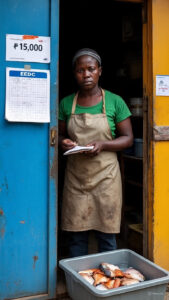
But survival has become a struggle she is losing. For over a month, there has been no steady electricity. She has relied entirely on her generator, running it from 9 a.m. to 9 p.m. every day. Fuel alone gulps down ₦15,000 daily. Yet, despite the darkness, her electricity bill from NEPA arrives boldly for power she never used.
Then come the silent losses. Twice, her freezer defrosted, fish and chicken spoiled. Goods worth ₦62,000 wasted! In just three weeks, her total loss climbed to ₦271,300. Her profit for March? A painful ₦38,000.

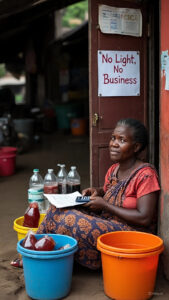
She worked every single day—31 days—only to end up losing ₦233,300. All because one problem remains unsolved. “Who is this country really for?” she asks, her question lingering in the air like a cry many are too tired to voice.
She is not alone. At Eke-Agba market, Isuaniocha, Mrs. Theresa Mba popularly called Mama Nkechi, who once sold cold zobo, a humble drink that fed her four children has watched her livelihood disappear. Without electricity, her zobo drink spoils within two days. Now, she has abandoned her business and returned to farming, struggling to feed her four children, who are currently out of school because she can no longer afford their fees.
Mr. Jerome Ikechi, a barber in the same community, has shut his shop completely. Without power, his clippers are useless. With a pregnant wife due in a month and a hospital bill of ₦180,000 hanging over his head like a dark cloud, hope feels distant.

Another neighbour runs a POS business. But without light—and often without network—transactions fail. “No service” has become a cruel phrase. “No service” means no withdrawals, and no withdrawals mean food on the table.
Isuaniocha is a growing community. There are schools and businesses. People pay taxes. They pay electricity bills. Yet, they are left in darkness, while nearby areas like Agu Awka enjoy stable power. And when they complain, they are told something almost insulting: “Buy solar.” “With which money?” the frozen food seller Mrs. Nwafor asks bitterly.
To power her shop with solar would cost about ₦1.2 million. But her entire business capital is just ₦400,000. Is she expected to borrow money to do the job of an electricity company—only to still receive bills for power she generates herself? Even in darkness, the bills keep coming. Estimated charges and service fees for services never rendered. It is not just money that is taken—it is dignity, stability, and peace of mind.
And as always, women bear the heaviest burden. They are the ones who buy food in bulk to save costs—only to watch it spoil without refrigeration. They are the ones whose small businesses—salons, tailoring shops, cold rooms—depend entirely on electricity to survive.
When the power goes, their income disappears. Water becomes scarce. Children go hungry. Homes grow tense. And then, there is fear. Dark streets invite danger. Theft rises. Women and young girls walk home in fear, navigating unlit roads just to fetch water.
This is more than a power outage. It is a quiet crisis! A crisis where an electricity company’s failure is not just cutting power—but cutting off income, safety, dignity, and peace of mind.
Until the lights return, the women of Isuaniocha and Okpuno will continue to pay the price of darkness—one lost business, one spoiled meal, and one broken hope.