

By Sylvia Tochukwu-Ngige
The alarm rang at exactly 5:00 a.m., but Ike was already awake, staring into the dim ceiling as though it held answers to his worries. Sleep had become a luxury he could no longer afford. His mind was constantly occupied with numbers that refused to make sense. As a civil servant, he had always believed in stability—the quiet promise that a government job would provide security and dignity. But lately, that promise felt distant, almost like a story told to comfort the hopeful.
He sat up slowly and reached for his small, worn notebook. Inside were careful calculations—rent, school fees, transport, food, electricity. Each figure told the same story: his salary had remained stagnant while everything else had doubled, even tripled. The rising cost of living felt like a relentless tide, swallowing his earnings before the month could even begin.

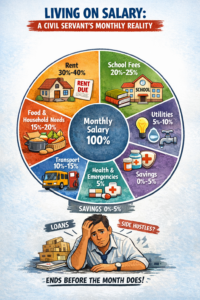
“Daddy, our teacher said we must pay the remaining school fees today,” Ada said gently, standing at the door in her neatly pressed uniform. Her voice carried innocence, but her words carried weight. Ike managed a faint smile. “I will try, my dear.” Yet, deep inside, he knew that trying was no longer enough.
School fees had become one of the greatest burdens for families like his. What used to be manageable had turned into a recurring crisis. Even public schools, once considered affordable, now demanded more than many could easily provide. Private schools were no longer an option worth discussing. Each term came with anxiety, quiet embarrassment, and sometimes humiliation when children were sent home for unpaid fees. Education, once seen as a basic right, was gradually becoming a luxury.
His wife, Ngozi walked in moments later, her face lined with worry. “The landlord came yesterday,” she said softly. “He said if we don’t complete the rent this month, we should prepare to leave.” Ike exhaled deeply. The rent had increased without warning, turning what used to be manageable into a heavy burden. Relocating would only mean moving farther away, increasing transport costs, and settling for poor living conditions.
At work, the atmosphere offered little relief. His colleagues, once cheerful and optimistic, now spoke in low tones filled with frustration. “I have three children at home,” one colleague said. “I don’t even know how we’ll survive next term.” Another added, “Transport alone is consuming half my salary. Before I even think about food or rent, the money is gone.” They laughed, but it was the kind of laughter that masked pain.
Civil servants like Ike had become silent sufferers. Every day, they dressed neatly and showed up to work, performing their duties with commitment, while battling unseen struggles at home. Many had taken loans just to stay afloat. Others depended on friends or relatives. Some tried small side businesses, but even those were barely enough in an economy where prices changed almost daily.
That evening, Ike walked home slowly, his thoughts heavy. He passed children playing along the roadside, laughing without care. For a moment, he envied their innocence—their ignorance of bills, rent, and responsibilities.
When he arrived home, Ada ran to him. “Daddy, did you pay the fees?” He knelt beside her, holding her gently. “Not yet, my dear. But we will find a way.” It was a promise born more from hope than certainty.
As darkness settled, Ike sat alone under a dim bulb, reflecting on his life. He had done everything right—gone to school, secured a government job, and worked hard. Yet, here he is, struggling to meet the most basic needs
The cost of living had turned survival into trench warfare. School fees felt like punishment. Rent letters read like eviction threats. Still, he glanced at his children sleeping on the mattress on the flour and his wife mending a uniform by phone light. That picture was his fuel.
In Anambra State, the story bends differently. Salaries land on time. Compared to States still on ₦30,000 minimum wage or owing arrears, workers here can breathe. The governor’s wage increase gave people room to plan, not just panic. But numbers don’t lie. Rent, food, and school fees are climbing faster than any paycheck. So even with ₦70,000–₦82,000, most civil servants still skip meals, pause building projects, or pull kids from after-school lessons to survive.
Yet, in the midst of hardship, one thing remained untouched—hope. And for Ike, that hope was enough to face another day.
Sylvia Tochukwu-Ngige Founder https://.www.sylviangige.com | Where women’s power meets real life.
Internal Links:
- How Inflation Is Affecting Nigerian Families
- The Rising Cost of Education in Nigeria
- Rent Challenges in Nigerian Cities
Outbound Links:
- National Bureau of Statistics – https://nigerianstat.gov.ng
- Central Bank of Nigeria – https://www.cbn.gov.ng
- World Bank – https://www.worldbank.org
- International Monetary Fund – https://www.imf.org